


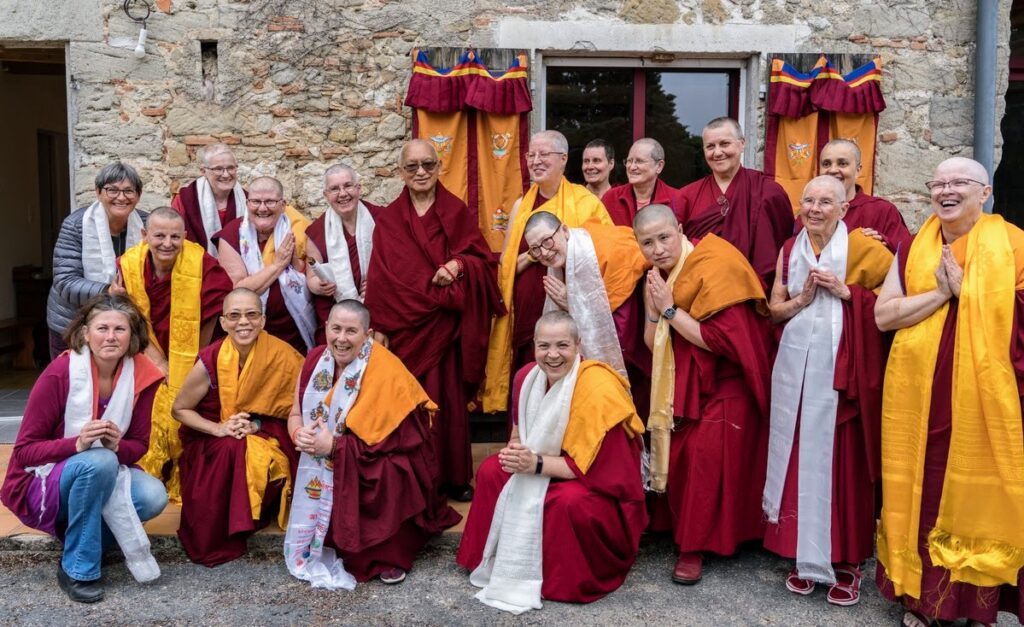
Dorje Pamo Monastery provides the monastic community with a conducive environment for observing their vows without distractions, contributes to the preservation and transmission of the Dharma teachings, and offers visitors a sacred space that fosters their spiritual development and the accumulation of merit.
Our mission
The primary mission of Dorje Pamo Monastery is to provide the nuns with a stable and harmonious monastic living environment conducive to spiritual practice. Community life is structured around prayer, study, and service, enabling each nun to cultivate mind training and inner qualities according to the Buddha’s teachings.
Whilst being a place of monastic practice, the monastery seeks to remain open to the world. It aspires to become a space of spiritual inspiration accessible to all, Buddhists and non-Buddhists alike, where the nuns put their meditative experience and understanding of the human mind at the service of the community; offering a place where people can find a warm welcome, be listened to and experience a sense of renewal.
The Sangha, Living Pillar of Dharma Transmission
The monastic community holds an essential place in the preservation and transmission of the Dharma. By receiving, practicing, and spreading the teachings, its members ensure the continuity of this spiritual experience through the ages.
While individual practice remains possible, without a structured framework ensuring the transmission of the message, practitioners would risk remaining isolated, like ephemeral stars destined to fade away without leaving a trace. It is therefore necessary to establish solid institutional structures to ensure the transmission of this spiritual realization across generations.
“Without genuine monastic communities and authentic monastic discipline, it will be very difficult to preserve the Sangha and spread the Dharma.”
Lama Zopa Rinpoche

There exists an authentic path leading to liberation from suffering. Confronted with illness, old age, death, and the figure of the ascetic, Prince Siddhartha renounced his worldly life to undertake his quest for freedom. This aspiration for liberation remains fully relevant today: it touches the very heart of the human condition, beyond eras and cultural boundaries.
Monastic life constitutes a fundamental component of the fourfold Sangha, which brings together fully ordained monks and nuns as well as lay practitioners, women and men. Wherever this four-branched community establishes itself, it forms the stable foundation upon which the teachings can take root and flourish as a living and enduring tradition.
.
The Story of Dorje Pamo Monastery
The history of Dorje Pamo Monastery is part of the history of Tibetan Buddhism’s arrival in the West in the second half of the 20th century, and more specifically the history of the FPMT (Foundation for the Preservation of the Mahayana Tradition).
– 1980 –
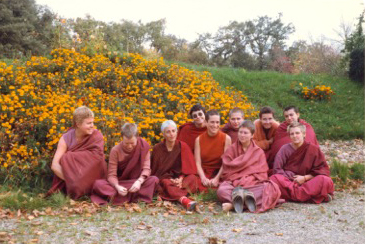
The founding lamas of this organization, Lama Thubten Yeshe and Lama Zopa Rinpoche, visited France in 1978 and 1979. One of the consequences of those visits was the creation of a Dharma center, the Vajra Yogini Institute, and of Nalanda Monastery for monks, in the Tarn department near Toulouse, France. The first Dorje Pamo Monastery was created in the 1980s in one of the large outbuildings of the Vajra Yogini Institute.
“Don’t think that what you are doing, you’re doing it for yourself.
You’re doing it for the nuns of the future.”
Lama Thubten Yeshe, who founded Dorje Pamo Monastery during his first visit in 1982.
A group of young nuns of diverse nationalities started a religious community. It was closely linked to the Institute and the neighboring monastery under the guidance of the resident Tibetan Lamas. Dorje Pamo was the first monastery in the Tibetan Buddhist tradition created for Western nuns.
Those present at the time remember the positive influence that the young nuns had on those around them and their enthusiasm for study, practice, and service. Read an article of Mandala magazine (1984).
– 1987 –
The Buddha taught that everything is in perpetual change, because of multiple causes and conditions, which are themselves in constant evolution. Therefore, after a number of years, the causes and conditions were such that the nuns were called upon to help out with management and teaching and in various FPMT centers. This was the end of the first generation of Dorje Pamo Monastery.
A few decades passed and the question of a monastery repeatedly came up in conversations. Then, beginning around 2010 nuns living in the area around Lavaur started to come together to regularly practice and discuss issues related to daily life, ethics and support for nuns.
– 2016 –
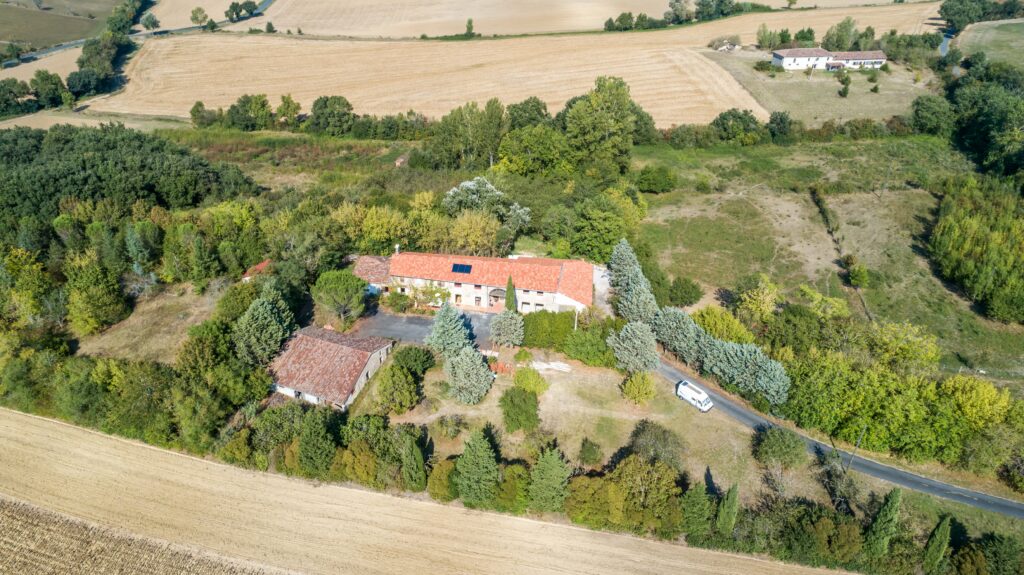
Thanks to the kindness of a generous donor and that of Vajra Yogini Institute, a property presenting the necessary conditions for the development of our project was acquired. Indeed, during 2016, we had the joy of receiving a donation of a property that includes a vast farmhouse and numerous outbuildings. Surrounded by six hectares of green spaces, it comprises orchards, meadows, woods, and a small pond. Our future monastery was finally found! Quite naturally, and following the recommendations of our spiritual director, Lama Zopa Rinpoche, who then gave his approval to the project, it regained its original name, Dorje Pamo Monastery.
– 2018 –
The project gained momentum. People volunteered. Plans were drawn up, and estimates for the renovations acquired.
The “major structural work” of the nuns’ accommodation part of the building started in March and was finished in the beginning of the summer. This included: repairs to the roof, changes of all door frames, creation of new rooms and new doors and windows, installation of a new heating system, and the complete renovation of electricity, plumbing, water supply and drains.
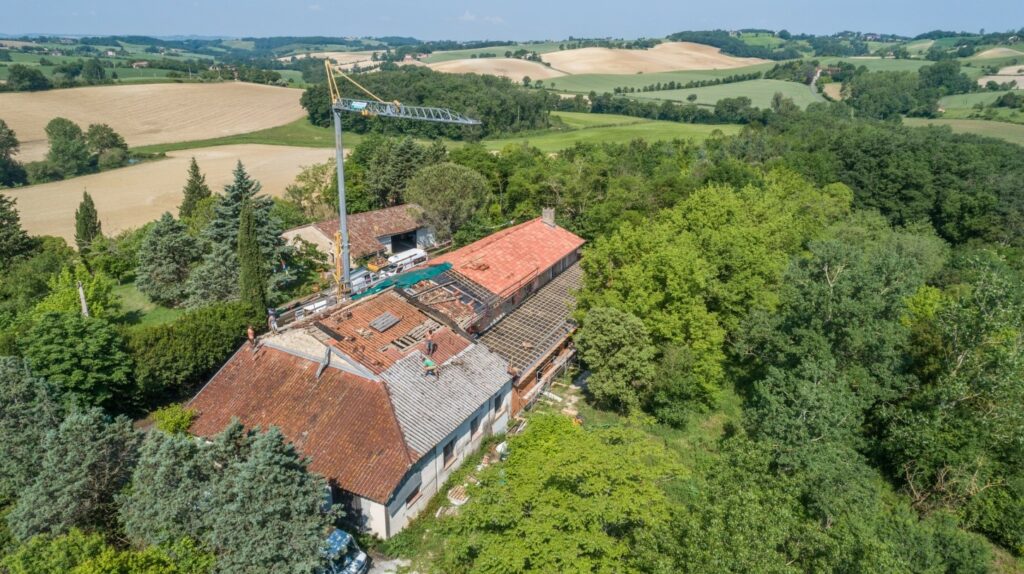
Before the first nuns could move in, the building required painting. Courageous groups of volunteers took turns throughout the summer working througH the oppressive heat to get the work done. The first nuns moved in, in September.
From the beginning of October, the professional workers (plasterers, carpenters, electricians, plumbers, and so forth), returned to resume work on the Gompa / Library / Reception areas.
– 2019 –
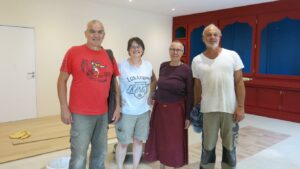
In August, work on the temple / gompa and library were nearly completed. Courageous volunteers put the floor boards in place. The beautiful altar was delivered and set in place.

— 2021 – 2022–
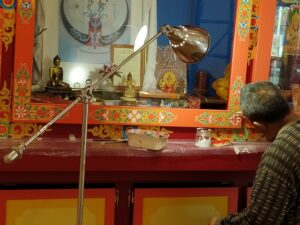
The altar was painted, according to the wish of Lama Zopa Rinpoche, with classical Tibetan decoration by the Nepalese artist Gelek Sherpa.
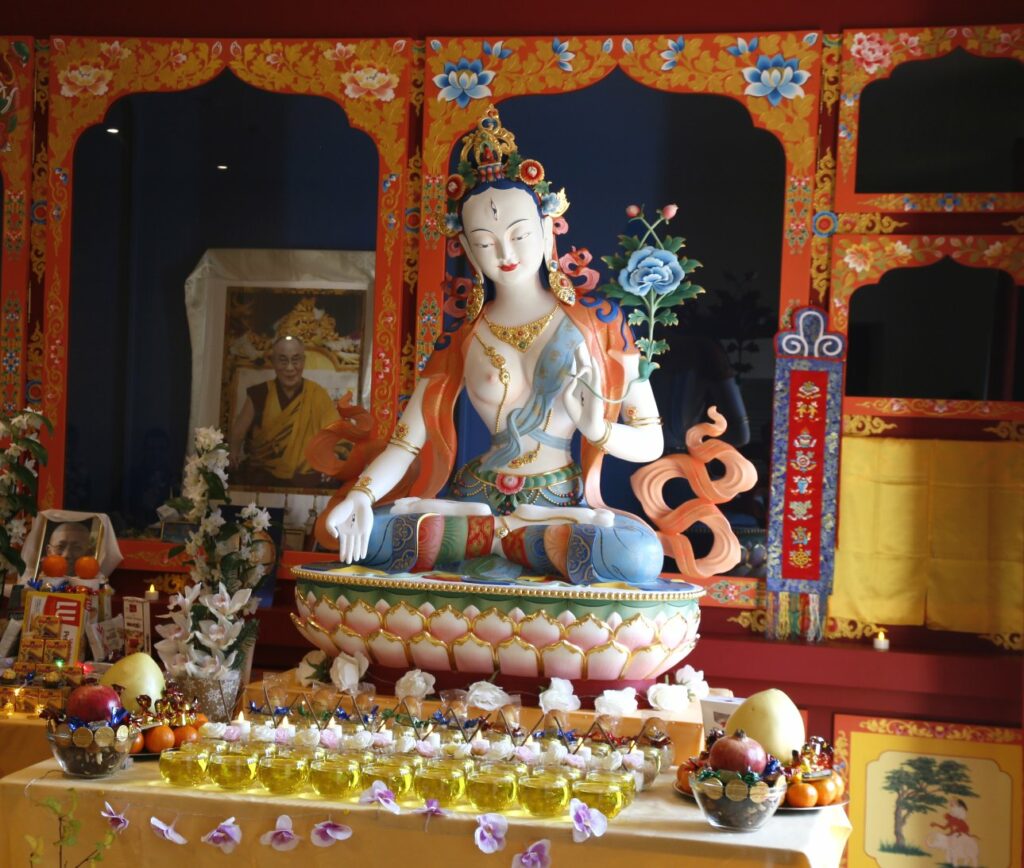
During the winter of 2022, the vajra frieze, the finishing touch to the altar, was installed by Peter Griffin and we welcomed the White Tara statue created by Denise Griffin and painted by Gelek, thanks to the sponsorship of a group of Taiwanese students who offered the statue for the long life of our precious Lama.
Location
We are fortunate that the monastery is in the middle of 6 hectares of countryside. This is a haven of nature conducive to recharging, meditation, and above all offers an ideal, peaceful haven for nuns to study, to practice and to work for the benefit of others.